Newsletter Subscribe
Enter your email address below and subscribe to our newsletter

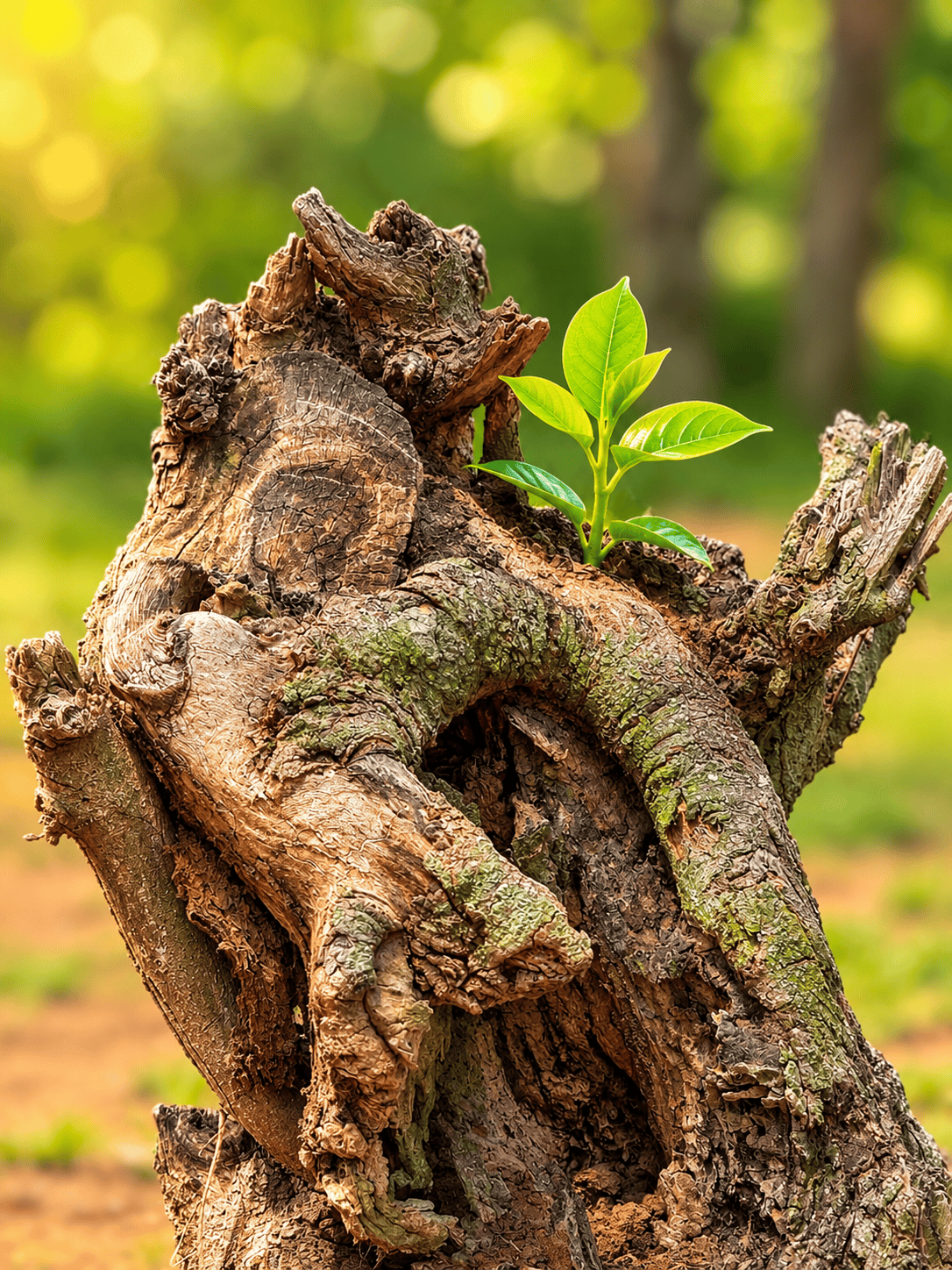
There is something I’ve been contemplating about this month, something that speaks to the idea of the hope for a tree that has been cut down.
I imagine that once, it stood tall. It had branches that stretched towards the sky, leaves that provided shade, and perhaps fruit that nourished those who came near it. It occupied space, served a purpose and carried the evidence of life. But now, it is a stump.
Its branches are gone. Its former appearance is a memory. What remains is a weathered structure bearing the marks of what has been taken away.
To someone passing by, there may be very little reason to pay attention to it. After all, what is there to admire about something that appears to have lost its usefulness?
Yet, every once in a while, something extraordinary happens. A small green shoot begins to emerge from the very place where life seemed to have ended. It is a quiet but powerful reminder that what appears lifeless may still hold the possibility of new beginnings.
In Job 14:7-9, we encounter this beautiful observation: “For there is hope of a tree, if it be cut down, that it will sprout again, and that the tender branch thereof will not cease. Though the root thereof wax old in the earth, and the stock thereof die in the ground; Yet through the scent of water it will bud, and bring forth boughs like a plant.”
These words are particularly interesting because of the circumstances from which they emerge.
Job was not speaking from a place of abundance or personal comfort. He was a man who had experienced devastating loss. His life had taken a turn he could neither have anticipated nor easily understood. He had lost his possessions, his children, his health and the familiar securities that once defined his world.
He knew what it meant to have life stripped of the things that made it recognisable.
And in the middle of this profound reflection on suffering and human mortality, he draws attention to a tree. Perhaps there is something here worth thinking about:
1. Sometimes, life does not turn out the way we imagined.
One of the more difficult realities of life is that not everything we sincerely desire, work towards or pray about unfolds as we envisioned. We make plans. We invest our time. We nurture relationships, pursue opportunities, build careers, establish families and develop dreams. We do so with the hope that our efforts will eventually produce something meaningful. And often, they do, but life also introduces us to experiences we did not prepare for…
May be a relationship we thought would last comes to an end. May be a business we invested everything in struggles to survive. An opportunity we waited years for passes us by. A loved one is no longer around. A season that once brought us joy becomes a source of grief. Sometimes, the hardest part is not even what happened. It is having to reconcile ourselves with a reality we never imagined we would have to live with.
We find ourselves asking questions we never thought we would ask. We revisit decisions, wonder what could have been different and occasionally struggle to recognise the life we are now living.
And perhaps we need to acknowledge that these experiences can hurt deeply. Faith does not require us to pretend that disappointment does not hurt. Hope does not demand that we rush through grief or manufacture a smile when our hearts are still processing loss.
There is room to grieve what did not happen, to acknowledge what has changed and to be honest about what we wish had turned out differently.
But there is also something important to remember: the fact that life has taken an unexpected turn does not mean that its possibilities have been exhausted.
2. Do not confuse what is visible with all that is possible.
When a tree is cut down, what attracts our attention is what is no longer there. We see the missing branches, the absent leaves and the damaged trunk. We assess its condition based on what our eyes can observe.
But beneath the ground, there may still be roots capable of sustaining new growth. This is perhaps one of the most profound lessons we can draw from the imagery.
We are often inclined to measure life by what is immediately visible. We measure progress by achievements, growth by numbers, success by milestones and fulfilment by how closely our present circumstances resemble our expectations.
Consequently, when these visible indicators disappear, we sometimes begin to question whether anything meaningful is still happening.
But not everything valuable is immediately visible.
There are seasons when growth takes place internally before it becomes externally evident. There are lessons we only appreciate after difficult experiences. There is character that is developed through responsibility, wisdom that emerges through disappointment and faith that matures when we must trust God without having all the answers.
Sometimes, what appears to be a season of inactivity is actually a season of preparation.
This does not mean that every difficult experience is necessarily a hidden blessing or that we should romanticise suffering. Some experiences are simply painful, and they deserve to be acknowledged as such.
But we must be careful not to make permanent conclusions about our lives based on temporary visibility. You may not be where you hoped to be. You may have less than you once had. You may be navigating a reality that requires you to start again.
Still, there is more to your story than what your present circumstances reveal.
3. Hope does not always announce itself loudly.
One detail in Job’s observation is particularly fascinating. He speaks of a tree that begins to bud at the scent of water.
There is something almost poetic about that picture. A tree that has endured the elements, lost its branches and stood through what appeared to be the end of its usefulness responds to the possibility of nourishment.
The emergence of new life does not begin with an elaborate announcement. It begins with a small indication that conditions for growth may once again be present. Perhaps this is how hope sometimes finds its way back into our lives.
It may begin with a conversation that gives us a different perspective. A small opportunity that reminds us we still have something to offer. A moment of prayer that brings a little peace to an otherwise unsettled heart. A person who shows up when we least expect it. A renewed desire to try again after a prolonged season of disappointment.
These moments may not immediately change our circumstances, but they can change how we approach them. And sometimes, that is where a new beginning starts. We must learn not to despise small beginnings. Not every breakthrough arrives dramatically. Not every restoration is immediately recognisable.
Sometimes, the first indication that we are healing is simply that we are beginning to find the strength to engage with life again.
Sometimes, hope looks like getting out of bed after a difficult night. Sometimes, it looks like having the courage to trust again. Sometimes, it is simply finding the willingness to take one more step. And that, for me, counts.
4. Restoration does not always mean returning to what was.
There is an important distinction between hoping for restoration and becoming attached to the exact form of what we have lost.
When we experience loss, our natural inclination is often to want things back exactly as they were.
We want the relationship restored to its former state, the opportunity returned, the business revived, the familiar environment reinstated or the life we once knew made available to us again.
And there is nothing inherently wrong with desiring restoration. However, sometimes our attachment to the past can make it difficult for us to recognise the possibilities of the future.
We can become so preoccupied with recovering what was that we struggle to appreciate what can still become.
A tree that sprouts again does not necessarily reproduce its former branches in exactly the same way. New growth emerges, new leaves appear, and the tree continues its story, but the expression of that life may look different.
Perhaps we need to make room for this understanding in our own lives. Sometimes, healing means learning to live meaningfully after something has changed permanently. Sometimes, moving forward means accepting that a particular chapter has closed without concluding that the entire book has ended.
Sometimes, God does not take us back to where we were. He leads us into a future we had not previously imagined. And perhaps one of the most mature expressions of hope is learning to trust God with a future that does not have to resemble our past.
5. Our hope is ultimately anchored in God, not in the predictability of life.
It is important to recognise that Job’s words emerge from a much deeper struggle than the simple observation that trees can grow again.
Job was wrestling with suffering, mortality and the apparent unfairness of his circumstances. His reflections were not an uncomplicated declaration that everything would soon return to normal.
In fact, much of the book of Job confronts us with the reality that faithful people can experience seasons they do not understand. This is important because our faith should not be built on the assumption that everything will always work out according to our preferred timelines or expectations.
There are prayers whose answers take longer than we anticipated. There are situations that do not resolve the way we hoped. There are losses for which earthly restoration may never be possible.
So, where does hope find its foundation? Romans 15:13 introduces us to a beautiful description of God as the God of hope, who fills us with joy and peace in believing, so that we may abound in hope through the power of the Holy Spirit. Our hope is not merely in the possibility of better circumstances. It is in the character of God.
It is in knowing that His faithfulness is not determined by how favourable our circumstances are. His presence is not diminished by our unanswered questions, and His ability to sustain us is not dependent on our ability to understand everything happening around us.
This is the kind of hope that can coexist with grief, uncertainty and even unanswered questions. It allows us to acknowledge that something hurts without surrendering our confidence in God.
It gives us the courage to keep living, loving, serving, believing and growing, even when the future is not entirely clear.
I find myself returning to the image of that tree stump after taking a picture of it on some island.
There is something about it that captures the human experience in ways we sometimes struggle to articulate.
We all encounter seasons that leave marks on us. Some experiences change our plans. Others change our relationships, our priorities, our perspectives and even the way we understand ourselves.
There are moments when we look at our lives and struggle to reconcile what we once imagined with what we now see.
And in those moments, we must give ourselves the grace to acknowledge the reality of where we are without assuming that this is all we will ever be.
Wherever you find yourself today, do not be too quick to pronounce the end of your story. You do not have to have everything figured out today. You do not have to manufacture strength when you are weary. You do not have to know exactly how the next chapter will unfold.
But you can remain open to the possibility of new growth. You can allow yourself to heal. You can embrace new beginnings. You can trust God with the things you cannot change and remain expectant about the things that are still possible.
After all, the tree does not need to look the way it once did for new life to emerge. And perhaps that is the reminder we need:
What looks like an ending is not necessarily the end.
The truth is that sometimes, the future holds possibilities that our present circumstances cannot yet reveal. And through it all, God remains faithful.
May we have the grace to acknowledge what has ended, the courage to embrace what is changing, and the faith to remain hopeful about what is still possible.
There is still hope. The tree can sprout again.
Stay Blessed!